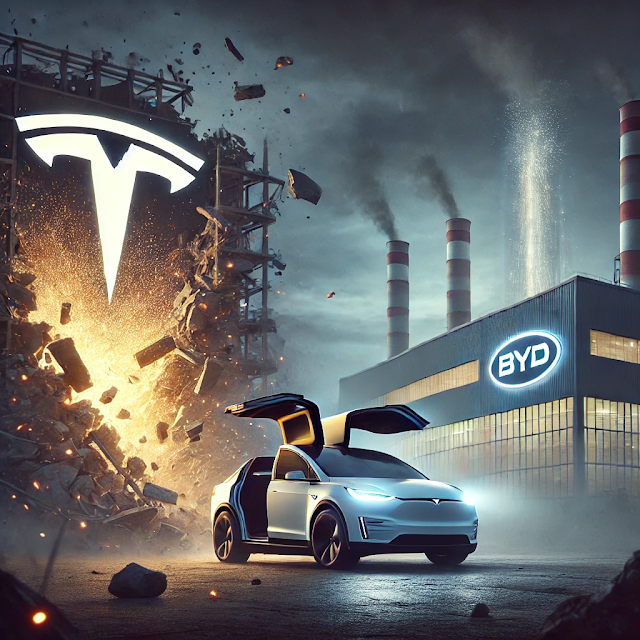
Once the poster child of innovation, Elon Musk’s Tesla is now being outmaneuvered, outproduced, and, let’s be honest, outclassed by a competitor many once scoffed at — China’s BYD. As the electric vehicle (EV) landscape enters its next chapter in 2025, Tesla’s stumble is BYD’s cue to take the crown. And take it they have — ruthlessly, efficiently, and with absolutely no regard for Tesla’s former dominance.
Let’s break down how Tesla went from “the Apple of Automobiles” to a tech-laden cautionary tale, and how BYD quietly became the industry’s new Goliath.
1. The Fall of a Titan: Tesla’s Reputation Burnout
Let’s start with the obvious: Tesla is floundering.
The company's stock has been sliding down faster than a Cybertruck door panel in a crash test. Yes, markets are turbulent in general, but Tesla’s decline is more self-inflicted than macro-driven. Elon Musk’s increasingly erratic behavior, coupled with a growing sense that the company's best days are behind it, is creating the kind of investor anxiety typically reserved for meme stocks and doomed SPACs.
Tesla’s reputation, once bulletproof, is now a cracked windshield in a hailstorm. According to recent Brand Finance surveys, Tesla’s brand trust is tanking globally. From being seen as a symbol of future-forward brilliance, Tesla is now embroiled in PR disasters, political polarization, and the worst sin of all in capitalism — stagnation.
Just this week, over 14,000 Cybertrucks were recalled due to faulty parts. A truck that looks like it time-traveled from Blade Runner can’t even stay intact at 70 mph. That’s a bad look for a company promising “Full Self Driving” and interplanetary travel.
Meanwhile, Elon’s increasingly partisan political endorsements — including a not-so-subtle shoutout from Donald Trump — have further alienated Tesla from European and liberal consumers. Add that to a bizarre plug from Commerce Secretary Howard Lutnick on Fox News, and you’ve got a company more wrapped up in culture wars than engineering excellence.
2. BYD: The Quiet Assassin Turned Market King
While Tesla’s been busy playing “Twitter CEO: The Home Game,” BYD has been, well, actually building things. Like EVs. Lots of them.
BYD (Build Your Dreams — and, apparently, your competitor’s nightmares) has emerged as the global leader in EV production. As of February 2025, BYD commands a staggering 22% market share, officially surpassing Tesla. The torch has been passed — or more accurately, wrenched away with precision and a lithium-powered crowbar.
Why? Because BYD didn’t try to be cool. It tried to be competent.
In contrast to Tesla’s bloated price tags and mid-life crisis Cybertrucks, BYD focused on affordability, reliability, and scalability. From the compact Seagull to the luxurious Han EV, BYD has a model for nearly every consumer demographic — and each one undercuts Tesla in price without sacrificing quality.
This isn't a one-off spike in sales. It’s a calculated, strategic rise.
3. BYD’s Masterstroke: A Triple Threat Strategy
So how did BYD pull this off? Three key moves:
3.1 European Expansion at Tesla’s Expense
Let’s talk timing — BYD’s has been impeccable. Just as Tesla’s European sentiment started nosediving, BYD made its move.
BYD Vice President Stella Li confirmed that starting March or April 2025, BYD’s registration numbers in Europe would “jump.” That wasn’t a prediction — it was a threat. And it's being fulfilled in real-time.
The Seagull, BYD’s answer to European compact cars like the Renault 5 and Citroën C3, is arriving at the perfect moment. Affordable, stylish, and backed by a massive marketing blitz (including sponsoring the European Championships), it’s already winning hearts.
Let’s be real: Europeans love quality and despise arrogance. BYD is bringing the former, while Tesla, thanks to Elon’s Twitter tantrums and American-centric branding, has embraced the latter.
3.2 Five-Minute Charging: The Range Anxiety Killer
While Tesla has rested on the laurels of its supercharger network, BYD just reinvented the game.
In a move that stunned the industry, BYD unveiled a 5-minute charging station — yes, five minutes. That’s not just competitive; it’s a paradigm shift. Backed by plans to roll out 4,000 of these ultra-fast charging stations across China, BYD is turning the #1 EV deterrent — range anxiety — into a quaint memory.
We’ve been saying EVs need to be as convenient as gas cars. BYD just went ahead and did it.
3.3 God’s Eye: A Technological Uppercut to Tesla’s FSD
Tesla’s Full Self Driving (FSD) system — recently rebranded as "FSD (Supervised)" — is still stuck at Level 2 autonomy, meaning drivers must remain attentive at all times.
BYD? They’ve leapfrogged Tesla with God’s Eye — an Advanced Driving Assistance System (ADAS) that’s available across multiple price tiers.
- God’s Eye C – base level.
- God’s Eye B – adds LiDAR and reaches Level 3 autonomy.
- God’s Eye A – three LiDAR units, pushing boundaries with features that Tesla promised years ago but hasn’t delivered.
Tesla spent years selling dreams. BYD built them into dashboards.
4. Let’s Talk Numbers: BYD’s Fundamentals Make Tesla Look… Delusional
While Tesla trades at a price-to-cash-flow ratio of over 50, BYD is sitting pretty at under 9. For the uninitiated, that’s a chasm as wide as Elon’s Mars ambitions and his actual accomplishments in AI.
BYD Valuation Snapshot:
- PEG Ratio: Under 2 (impressive for a high-growth company).
- Price-to-Cash Flow: Below 9.
- Revenue Growth: Outpacing the competition.
- Production Growth: #1 in EVs globally.
Tesla, on the other hand, is hoping its humanoid robots, Dojo chip, and a “maybe-someday” robotaxi will justify a market cap that’s starting to look like a fever dream.
5. Technical Trends: BYD is on a Breakout Streak
The technical charts are screaming bullish on BYD. After flirting with the $80 resistance level for months, BYD stock broke out in early March. While the RSI (Relative Strength Index) is currently overbought, analysts expect any dip to $80 to act as strong support.
Translation: If BYD dips, it’s not a sell — it’s a shopping spree.
Tesla? Analysts are desperately trying to draw support lines before they run out of y-axis real estate on their charts.
6. Risks? Sure, But Manageable
Let’s be fair. BYD isn’t without risk.
It’s a Chinese company, which means geopolitical tensions — especially U.S.-China trade friction — could impact sentiment. However, unlike some Chinese tech stocks caught in regulatory crossfire, BYD has state backing, global appeal, and diversification into non-U.S. markets.
The bigger risk? Ignoring BYD entirely while clinging to Tesla stock like it’s still 2020.
7. The Final Nail: Tesla’s Legacy Is Not Its Future
Tesla will always be credited with popularizing EVs. But legacy alone doesn't secure future dominance. Tesla is starting to resemble BlackBerry — an innovator that didn’t evolve quickly enough while competitors stormed in.
Yes, Elon Musk has projects. Lots of them. SpaceX, Neuralink, X (formerly Twitter), Optimus robots, chips, AI... But as far as EVs go? He’s playing a distracted emperor while the barbarians — or in this case, BYD — are inside the gates, repainting the palace.
Tesla’s valuation is still pricing in wild, multi-industry success — an impossible ask, especially when the core business is losing ground to a nimble, hungry competitor.
8. The Strategic Play: Don’t Short Tesla — Buy BYD
Shorting Tesla might be tempting, but that’s a high-risk maneuver that only Wall Street gunslingers with unlimited margin accounts should attempt.
Instead, the smarter move is to go long on BYD.
Why?
- Market leader in EVs.
- Technological edge in charging and autonomy.
- Global expansion into a Tesla-fatigued Europe.
- Better fundamentals.
- Strong support levels and technical tailwinds.
Any dip near $80 per share is a green light for investors looking to ride the EV wave — not watch it crash into a Tesla recall.
Conclusion: The Crown Has Been Claimed
Tesla fans may still chant “to the moon,” but it’s BYD that’s actually ascending — not just in valuation but in real-world impact, product execution, and investor sentiment.
Tesla’s empire isn’t just under siege — it’s crumbling. And while Elon tweets through the chaos, BYD quietly builds. Factories. Chargers. Cars. Empires.
If Tesla was the past of EVs, BYD is the future — and that future has already arrived.
Disclosure: This article discusses securities that may not trade on major U.S. exchanges. Always perform your own due diligence and consult with a financial advisor.
Comments
Post a Comment